Artificial Turf for Trash and Recycling Pads in FL
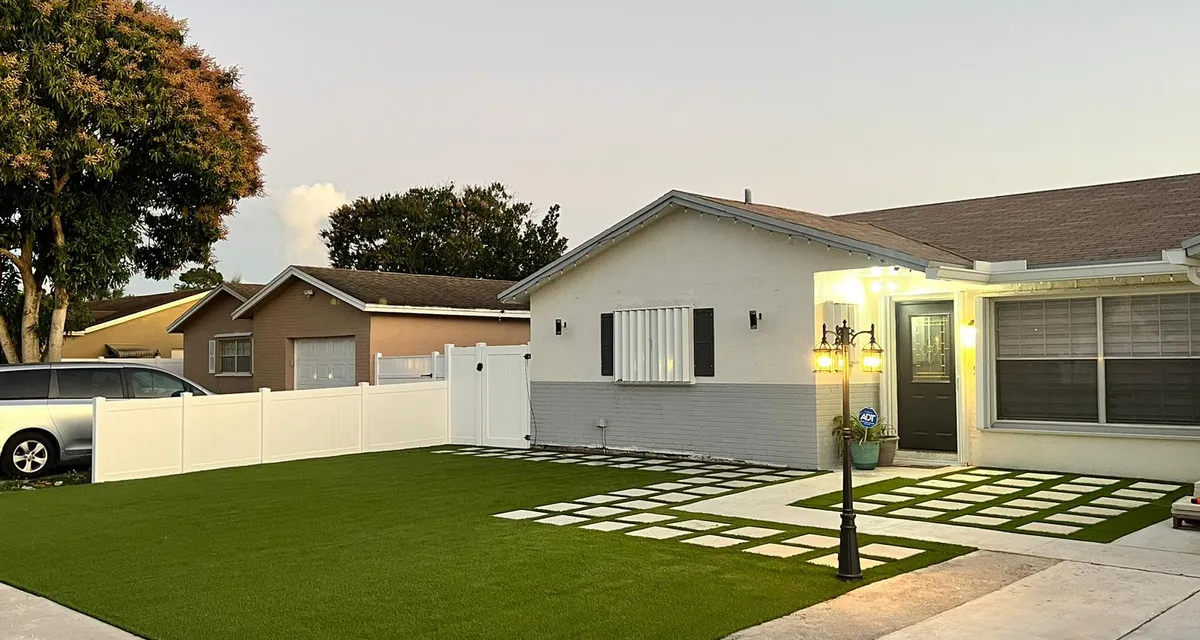
Every house in Broward and Palm Beach County has one: the narrow corner by the fence, the gap beside the AC pad, or the strip along the driveway where the trash can and recycling bin wait between pickup days. It’s almost never finished on purpose - it’s bare dirt or gravel because nobody wants to spend design budget on a spot that only gets looked at one morning a week. Artificial turf for a trash and recycling pad fixes that corner for less than most homeowners expect, and it solves a problem gravel and pavers only partly solve: mud after rain, weeds working through the gravel, and a patch of dead grass that never fully bounces back between bin trips.
Deciding whether the corner needs its own surface at all
Not every bin spot needs a project. A corner that’s already paved, or fully hidden behind a solid wall with good drainage, can usually stay exactly as it is. The ones worth fixing are the in-between spots - a narrow run beside a fence line, an open corner at the edge of a driveway, or the gap next to a utility pad - where bare dirt turns to standing mud every time it rains and where an HOA letter is more likely to show up than a compliment. Newer construction in Weston and Parkland runs into this constantly: the builder graded and seeded the main yard and left the utility corners as an afterthought, which is the same pattern covered in Govorex’s guide to turfing a narrow side yard.
Weighing gravel, pavers, and synthetic turf for a spot nobody shows off
Gravel is the cheapest fix on paper, but it migrates into the lawn, gives weeds a place to root between the stones, and never quite stays raked flat once bins roll across it a few times. Pavers solve the mud problem permanently but cost more to install than the spot usually justifies, especially for an area that’s only a few feet across. Synthetic grass lands in between on upfront cost and ahead of both on upkeep - no weeding, no re-raking after a storm, and a surface that sheds water through a permeable backing instead of holding it. For a utility corner this small, that’s usually the deciding factor over sheer price.
Sizing a project that’s smaller than it sounds
A typical bin corral or utility pad runs a fraction of the square footage of a full yard conversion, which means the total cost and the time on-site are both smaller than homeowners assume going in. Most installs - bin pad included - wrap within 48 hours once the base work is done, and a project this size often gets scheduled alongside a larger yard conversion in Delray Beach or Boca Raton rather than booked as its own visit. Getting an exact number only takes a few minutes through Govorex’s instant quote tool.
Adding screening on top of the ground cover
Turf answers what’s underfoot; it doesn’t hide the bins themselves from the street or a neighbor’s patio. For that, Govorex pairs the turf pad with an artificial ivy privacy wall or a lattice panel, specified at the same visit so the ground cover and the screening work as one finished corner instead of two separate projects tackled a year apart. That combination is also the detail HOA boards tend to approve fastest, since it addresses both the drainage complaint and the visibility complaint in a single submission.
What gets settled at the free consultation
The exact turf spec, base depth, and whether screening gets added all come down to what the specific corner is working with - slope, existing drainage, and how close the spot sits to a fence or property line. Govorex has handled this exact niche across Broward and Palm Beach County for 15-plus years, and every installer on the crew is licensed and insured for the work. A short on-site visit settles the real numbers; nothing about a bin pad gets guessed from a photo or a phone call.
Want your yard's real number? Outline it on a satellite map and see starting prices and a 12-month payment plan in about a minute — no sign-up.
Try the Instant Quote Calculator →