Artificial Turf Around Koi Ponds in South Florida
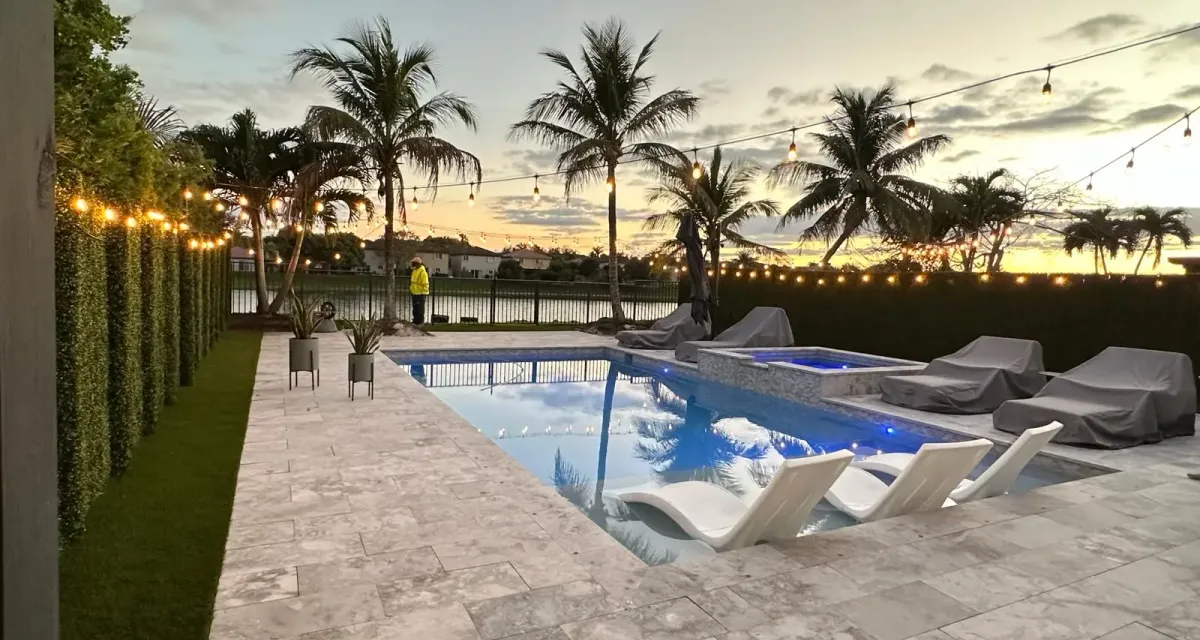
A backyard koi pond or sphere fountain changes exactly one thing about a turf installation: where the edge goes. Everything else — the compacted base, the permeable backing, the 48-hour install window — works the same whether a yard has a water feature or not. What trips people up isn’t the turf, it’s the sequence of decisions around the water itself, and homeowners across Broward and Palm Beach County tend to land on the same three questions in roughly the same order once a free consultation gets underway.
Decision one: flush edge, or a buffer border?
The first call is whether turf runs straight to the waterline or stops a few inches short behind stone, pavers, or a steel edge. A flush edge looks seamless, but it also means anything that lands on the turf near the pond — fish food, mulch, fertilizer drift from a nearby bed — has nowhere to go but into the water on the next hard rain. A buffer solves that without giving up much visually; most installs in Delray Beach and Boca Raton, where koi ponds and raised water features show up often on larger lots, use a narrow stone or paver collar a few inches wide, the same detail covered for garden beds in artificial turf pathways for garden beds.
Decision two: does the pond change how the base gets built?
Once the edge is settled, the second decision is really the installer’s to make, not the homeowner’s — but it’s worth understanding. A pond’s liner, pump lines, and any above-ground plumbing get mapped at the consultation, and the compacted aggregate base is built around those fixed points instead of running in an open grid. It’s the same adjustment a crew makes around a pool deck or an irrigation main, and it doesn’t add meaningfully to the standard installation timeline. Drainage still matters here the way it does on any turf project — see artificial turf and Florida’s rainy season if a yard with a water feature also floods easily, since the permeable backing that handles storm runoff is the same system that keeps a pond’s splash zone from pooling.
Decision three: turf the whole yard, or just the surround?
This is the decision with the most visible impact. Some homeowners turf everything right up to the pond’s buffer as one continuous lawn — the more common choice on a smaller or mid-size lot in Parkland or Jupiter, where the water feature is the yard’s focal point and the rest of the grass just frames it. Others keep a planted or graveled zone around the pond and turf only the open lawn beyond it, which tends to show up on larger properties where the pond sits inside its own landscaped nook rather than in the middle of open grass. Neither is more “correct” — it’s a layout preference, and either one gets priced in the same visit.
Where financing and the next step fit
None of these decisions move the baseline rate. Residential artificial grass still starts at $6.99 per square foot installed, with financing split as 50% down and the remaining balance spread across 12 equal monthly payments, no interest, subject to approval. The pond or fountain adds a mapping step and a buffer-material line item at most — not a different pricing tier or a longer install.
Anyone with a koi pond, fountain, or planned water feature should mention it when booking. It gets mapped as part of the same free on-site visit that scopes the rest of the yard, with a crew carrying 15+ years of experience, licensed and insured, serving homeowners throughout Broward and Palm Beach County. Run the yard’s dimensions through the instant quote tool for a starting number before that visit.
Want your yard's real number? Outline it on a satellite map and see starting prices and a 12-month payment plan in about a minute — no sign-up.
Try the Instant Quote Calculator →