Artificial Turf Pathways for Garden Beds in South Florida
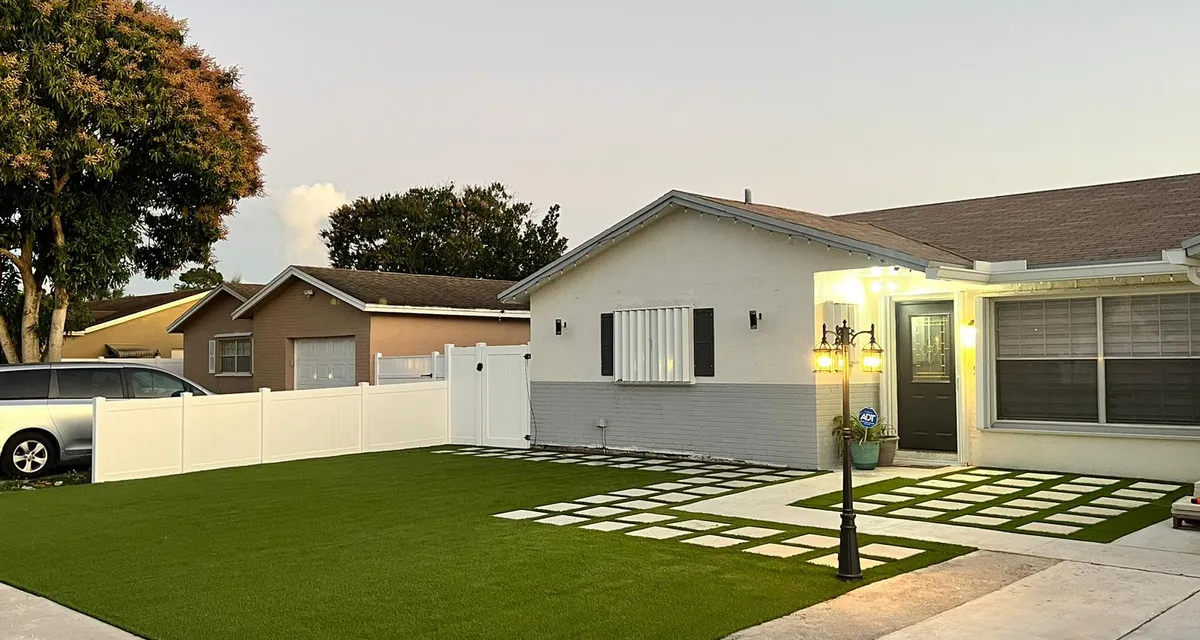
Bare dirt between two raised garden beds turns to mud in a single hard rain, and the mulch or gravel most people fill that gap with doesn’t fare much better - it compacts, migrates onto shoes and nearby pavers, and needs topping off every year or two as it breaks down. Artificial turf solves that specific problem in a way sod never could: a two- or three-foot-wide strip that drains instantly, never needs mowing in a space too narrow for a mower anyway, and stays green year-round between beds that get watered, fertilized, and dug into on a regular basis. It’s a narrower, more utilitarian use of synthetic turf than a full lawn conversion, and it’s come up more often at Govorex consultations as home vegetable and cutting gardens have become a fixture in established neighborhoods across Broward and Palm Beach County.
Why do mulch and gravel paths between raised beds turn into a mess?
Organic mulch breaks down fast in South Florida’s heat and humidity, turning soft and slick well before it’s due for replacement, and gravel - without a hard edge holding it in place - works its way into the surrounding soil a little more with every wheelbarrow trip or watering can refill. Neither material was built to handle the specific combination of standing water, foot traffic, and loose garden soil that a working bed layout produces, which is why the path between beds is usually the first part of a home garden to look unfinished, even when the beds themselves are well tended.
Does artificial turf hold up against soil, fertilizer, and regular watering?
A permeable-backed turf system drains overspray from drip lines or a hand-watering can the same way it drains rain, so standing water isn’t a concern on a garden path the way it is on open dirt. Granular or liquid fertilizer that drifts onto the turf during a normal feeding rinses off with the next watering rather than staining or breaking down the fibers, since synthetic yarn has nothing organic in it for fertilizer to interact with. The only thing worth avoiding is a contact weed killer applied directly to the turf itself - those products are formulated for soil and live foliage, not synthetic grass, and there’s no reason to need them on a path with nothing growing through it.
How is a garden path built differently from a full lawn?
The base principles don’t change - a compacted aggregate base and a properly draining backing still matter - but the scope is tighter and the shape is usually less regular, routing around bed corners and irrigation risers instead of running in open rectangles. A steel edging strip along each bed is what keeps the path’s cut line crisp against the soil over time, the same detail covered in artificial grass edging options for a standard lawn, just scaled down to a few linear feet per bed instead of a whole yard’s perimeter.
What does a path like this cost next to a full-yard conversion?
Because a garden path is a run of narrow strips rather than an open lawn, the square footage - and the total - usually comes in well under what a full-yard artificial grass conversion runs, even at the same $6.99 per square foot starting rate for landscape-grade turf. Homeowners in Jupiter and Delray Beach with established raised-bed gardens have had Govorex quote just the path sections on their own, leaving the rest of the yard as sod, gravel, or open soil for a later project.
Can the path be expanded if the garden layout changes later?
A garden path is one of the easier partial projects to build on, since the base work along one run of beds doesn’t depend on what happens to the rest of the yard. If a garden expands, gets reorganized into new bed rows, or eventually gives way to a larger landscaping plan, the existing turf path’s base and edging stay usable as a starting point rather than something that has to be torn out first. That flexibility is one reason it works well as a smaller first step for a homeowner in Palm Beach Gardens or Parkland who isn’t ready to commit to turfing an entire yard yet.
How do you get a garden path started?
A free on-site visit is where Govorex looks at an actual bed layout - how the paths route, where irrigation lines cross, what edging the project needs - before pricing anything. The instant quote tool gives a starting number, and residential artificial grass covers everything from a two-bed garden path to a full-yard conversion in one scope. Every project comes from a crew with 15+ years of experience, licensed and insured, typically finished within Govorex’s standard 48-hour window, serving homeowners throughout Broward and Palm Beach County, with financing available at 50% down and 12 no-interest monthly payments, subject to approval.
Want your yard's real number? Outline it on a satellite map and see starting prices and a 12-month payment plan in about a minute — no sign-up.
Try the Instant Quote Calculator →