Artificial Turf on FPL Easements in South Florida
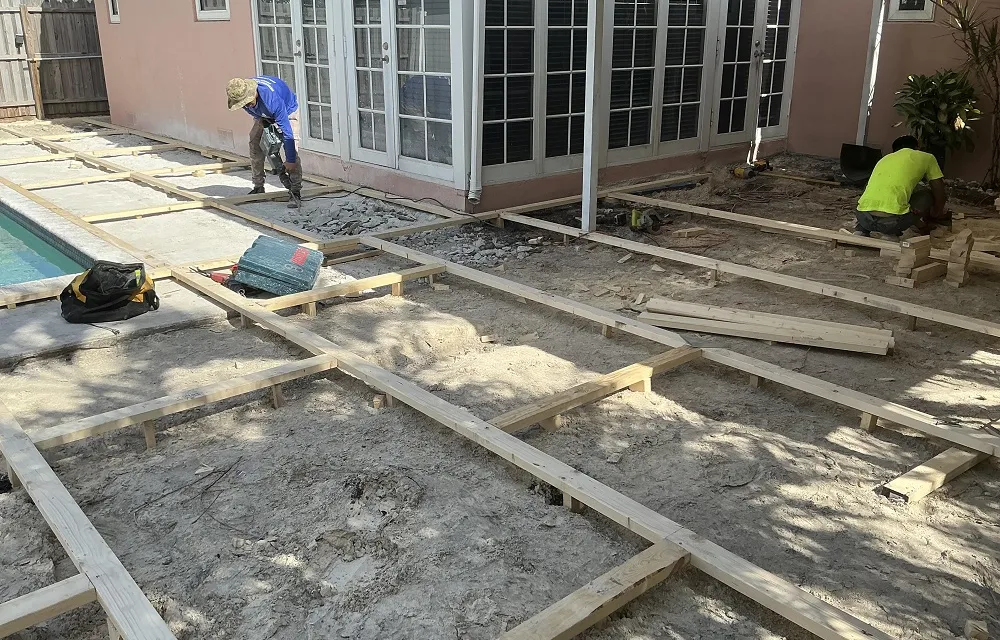
A surprising share of the yards Govorex measures across Broward and Palm Beach County have a strip that isn’t fully the homeowner’s to landscape however they’d like - an FPL power line easement running along a side or rear fence, or a canal maintenance bank that a drainage district or HOA has rights to access. Property owners often assume that restriction rules out artificial turf the same way it would rule out a shed or a planted hedge, and end up leaving a scrubby, mower-resistant strip of dirt or weeds instead. Most of the time that assumption is wrong. Synthetic turf is ground cover, not a structure, which is exactly why it tends to clear the bar that a fence, a tree, or a built addition wouldn’t.
| Strip type | Does synthetic grass usually work there? | What actually governs it |
|---|---|---|
| Overhead FPL power line easement | Yes | Pole and bucket-truck access must stay clear; no permanent structures |
| Underground FPL/utility easement | Yes | Line depth and dig-access rights; no trees or deep-rooted plantings |
| Canal maintenance bank/berm | Usually, with the right base | Mower or dredge access along the bank; erosion control |
| Drainage right-of-way strip | Case by case | Grading must keep water moving toward its intended path |
The table holds for the vast majority of sites, but every easement has its own recorded terms, so the first real step on any of these projects is confirming what’s actually on file rather than treating the strip like an ordinary side yard.
What an easement actually restricts
An easement grants a utility, a canal district, or sometimes the county the right to access a defined strip of a privately owned lot - it doesn’t transfer ownership of the ground. What it restricts is almost always permanent structures and anything that blocks the access the easement exists for: a shed built over an FPL line, a fence that blocks a canal bank’s mowing route, or a tree whose roots could reach buried cable. A rolled-out layer of turf sitting on top of graded soil doesn’t fall into that category, which is the distinction that makes most of these strips workable in the first place.
FPL’s rules for turf over or near power lines
Overhead easements exist mainly to guarantee clearance for bucket trucks and line crews to reach the poles and the wires above - they’re not typically concerned with what’s growing at ground level, provided it’s low and doesn’t require equipment that would interfere with a pole base. Underground easements are more about dig rights: FPL needs to be able to trench and repair buried cable without a homeowner’s landscaping standing in the way permanently. Turf doesn’t block either kind of access, since it lifts out in sections if a crew ever does need to dig, which is a meaningfully easier repair than regrowing sod or replacing a planted bed.
Canal banks carry a structural job, not just a cosmetic one
A canal maintenance berm is often doing double duty as erosion control for the waterway itself, which means the base underneath synthetic turf there has to be built differently than a flat backyard lawn. Govorex typically specs a root barrier and a compacted, slope-stable base on a bank section, distinct from the standard base used on the rest of a property, so the turf doesn’t contribute to slippage or interfere with whatever mowing or dredging schedule a drainage district runs along that canal. Owners in canal-lined communities around Weston and Coral Springs see this most often, where a backyard runs straight to a canal bank that’s technically outside the fully private portion of the lot.
Who actually has to sign off
An easement strip usually means more than one approval layer: the HOA or architectural board still reviews the turf the way it reviews any exterior change, and the underlying easement holder - FPL, a canal district, or the county - has its own access terms that have to stay satisfied regardless of what the board approves. Govorex pulls together the same spec sheet and sample used for a standard residential approval, scoped to note that the strip respects the recorded access route, which is usually what moves an approval through without a second round of questions. Communities near Fort Lauderdale with canal-front lots and HOA review in the same breath go through both steps on a single packet rather than two separate ones.
What it costs
Landscape-grade artificial grass starts at the same $6.99 per square foot installed rate used across every Govorex project, and because an easement or canal-bank strip is almost always narrow, the total for that section tends to land on the smaller side of a project - the exact figure depends on the strip’s length, slope, and whatever base work the site actually needs, confirmed at a free on-site consultation. Govorex’s standard financing applies here too: half the project cost at the start of installation, the balance split evenly across 12 monthly payments with no interest, subject to approval. Most installs finish within 48 hours. Anyone with a utility or canal strip they’ve been mowing around for years can get a real starting number with the instant quote tool, or read how a similar access-driven strip gets handled in Govorex’s guide to artificial turf drainage swales.
Want your yard's real number? Outline it on a satellite map and see starting prices and a 12-month payment plan in about a minute — no sign-up.
Try the Instant Quote Calculator →