Artificial Turf on a Swale in South Florida
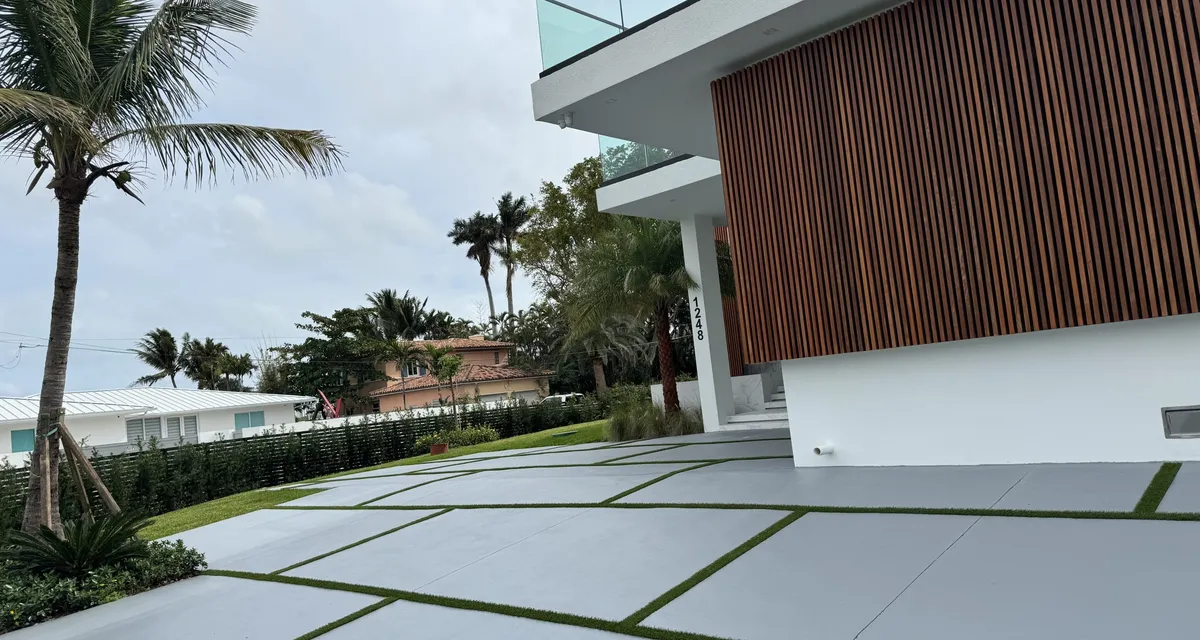
Ask most homeowners in Broward or Palm Beach County what they own between their sidewalk and the street, and the honest answer is “I’m not totally sure” - that narrow strip of grass is a swale, and it’s one of the most common sources of confusion when someone starts pricing out artificial turf for a property. The strip usually isn’t owned by the homeowner at all, yet it’s the homeowner who mows it, waters it, and watches it go patchy in the dry season right along with the rest of the synthetic grass candidates on the property. Turfing it raises a different set of questions than a backyard conversion does, mostly because the swale has a job to do that a regular lawn section doesn’t.
Swale turf, at a glance
| Question | Short answer |
|---|---|
| Who owns the strip? | Usually the city or county, as part of the right-of-way |
| Does it block drainage? | No - turf is permeable and lets rain pass through to the swale below |
| Do I need sign-off first? | Check with local public works and, if applicable, the HOA |
| What does it cost? | Same $6.99/sq ft starting rate as any other lawn section |
Those four answers cover most of what comes up before a crew ever shows up, but each one is worth a closer look once a specific property and street are in the picture.
Who actually owns the strip by the curb
The swale sits inside a right-of-way that belongs to whichever municipality maintains the street in front of it, not to the lot it fronts - that’s true whether the home is on a quiet cul-de-sac in Parkland or a canal-front street in Weston. Homeowners are generally responsible for upkeep, which is why so many already treat it as part of the lawn, but anything that changes the surface - turf included - is worth a quick call to the local public works office first. It’s rarely a hard no; it’s usually a short conversation about keeping the strip permeable and graded the way it already is.
Why the swale still has to drain
A swale exists to carry stormwater away from the pavement during Florida’s heavy, fast-moving rain, and that function doesn’t change just because the surface on top switches from sod to synthetic turf. The backing underneath artificial grass is built to let water pass straight through rather than sheet off the top, so a properly installed swale strip keeps draining the same low point it always has - the base just needs to stay as porous as the soil it’s replacing, which is standard practice on every Govorex install, not a special spec for right-of-way work.
Getting it to match the rest of the yard
A turfed swale that looks different from the lawn behind it reads as an unfinished patch rather than a finished front yard, so the real work is in the transition - same blade color and pile height carried across the sidewalk, clean edging against the curb and driveway apron, and a seam placed where it won’t catch a mower or a stroller wheel. Homeowners in Coral Springs and Davie converting a full front yard usually have Govorex do the swale in the same visit, which keeps the color and grade consistent from the house all the way to the street rather than leaving a visible line where two different jobs meet.
A swale strip rarely justifies its own project - it’s almost always a small addition to a front-yard or full-property turf conversion, priced and installed in the same visit rather than as a separate job. Run the yard’s full dimensions, swale included, through the instant quote tool for a starting number, or book a free on-site visit through residential artificial grass and get a straight answer on what the strip by your curb actually needs before committing to anything.
Want your yard's real number? Outline it on a satellite map and see starting prices and a 12-month payment plan in about a minute — no sign-up.
Try the Instant Quote Calculator →