Artificial Turf Court Surrounds in South Florida
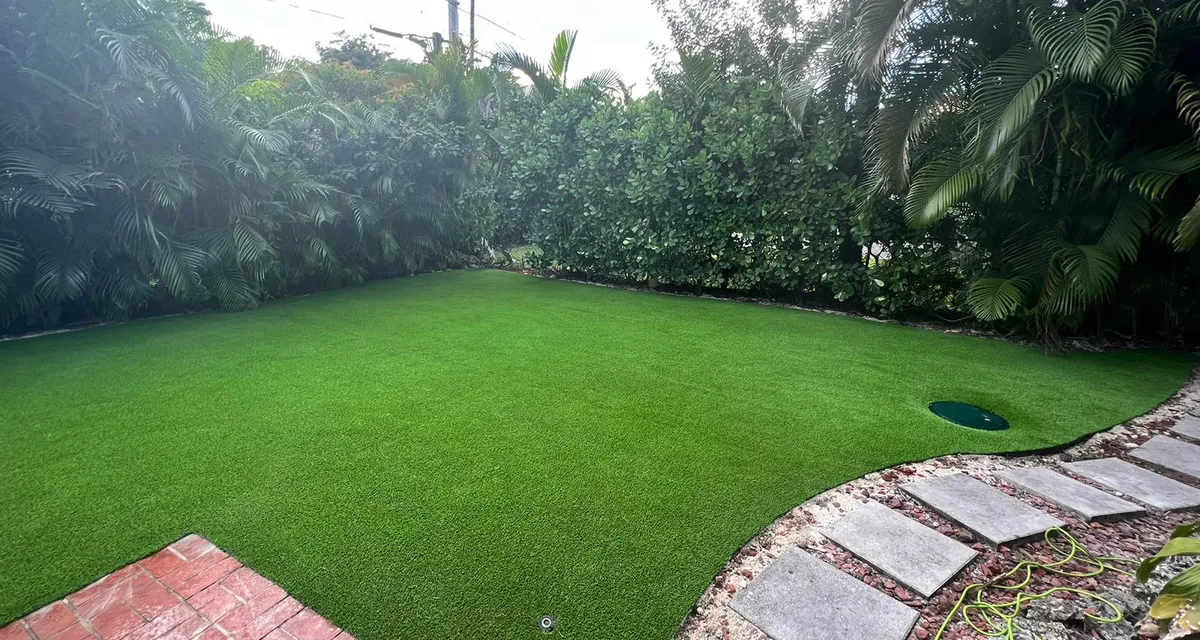
A homeowner in Weston built a regulation cushioned tennis court in the back corner of the lot years ago. The court itself still plays fine - it’s the four-foot strip of grass between the fence and the court apron that’s become the actual problem. It won’t hold a mower blade without scalping bare patches next to the fence posts, it turns to mud after every summer storm, and every lost ball disappears into grass long enough to hide it. That strip gets ignored for years because it isn’t the court - until it’s the reason the court feels neglected.
It’s a narrower version of a problem Govorex sees on full lawns across Broward and Palm Beach County: a patch of ground too awkward for a mower to maintain well, next to a surface that has to stay clean. Artificial turf solves it the same way it solves a pool deck border or a motor court apron, just scaled down to a few feet of width running the length of a fence.
Why the strip around a court fails faster than the rest of the yard
A fence line narrows the turning radius for a mower or a string trimmer, so a court surround gets scalped close to the posts and left shaggy everywhere a blade couldn’t reach - the same strip, two different heights, within a single pass. Add shade from a wind screen or privacy hedge along the fence, and that narrow band holds moisture longer than the open lawn around it, which is exactly the combination that turns bare dirt to mud first after rain. Synthetic turf doesn’t need the mower to get close to the posts and doesn’t thin out under the same shade that would thin a living lawn.
What the surround actually has to do for the players
A court surround isn’t decorative the way a lobby strip is - players are moving through it chasing balls, so the fiber and pile height matter more than they would on an ordinary side yard. Artificial grass cut short and dense sheds a stray ball instead of swallowing it, which keeps play moving and keeps someone from crouching in tall grass at the fence line mid-match. The same build also holds its line better under repeated foot traffic right at the court’s edge, where players plant and reach more than they would crossing an open lawn.
Pickleball adds a tighter footprint, not a different problem
Pickleball’s smaller court dimensions mean a shorter total run of surround turf than a full tennis court needs, which is part of why backyard pickleball has become such a common add-on for homeowners in Boca Raton and Parkland converting unused side yards. The surround still does the same job - a clean, mowable-free edge between fence and hard surface - just over less linear footage, which usually keeps the project smaller and the total cost lower than a tennis court’s full perimeter.
Getting it past a club or board
A private court on an estate lot or inside a country club community in Jupiter or Palm Beach Gardens usually sits inside the same architectural review that covers any other exterior change. A board or committee weighing the request wants to see how the material looks against the rest of the property and how the edge against the fence and court apron gets finished, not a different standard than it would apply to a lawn conversion. Govorex builds the same spec sheet and sample packet used for a standard turf approval, scoped to the court’s perimeter rather than the whole yard, so there’s nothing to redo once the committee signs off.
Paying for a smaller, specific project
Residential artificial grass starts at $6.99 per square foot installed, and because a court surround is usually a narrow strip rather than open acreage, the total tends to land well under a full-yard conversion - the exact figure still comes from measuring the actual run of fence line at a free on-site consultation. Financing works on Govorex’s standard structure no matter the project’s size: half down when the crew begins, the balance split evenly across 12 monthly payments with no interest, subject to approval. Most installs, court surrounds included, finish inside the standard 48-hour window. Anyone with a court already in the ground who’s ready to see real numbers can start with an instant quote, and anyone planning a full backyard court from scratch should look at Govorex’s guide to sports field turf for how the playing surface itself gets specified.
Want your yard's real number? Outline it on a satellite map and see starting prices and a 12-month payment plan in about a minute — no sign-up.
Try the Instant Quote Calculator →