Commercial Turf for Self-Storage Facilities in FL
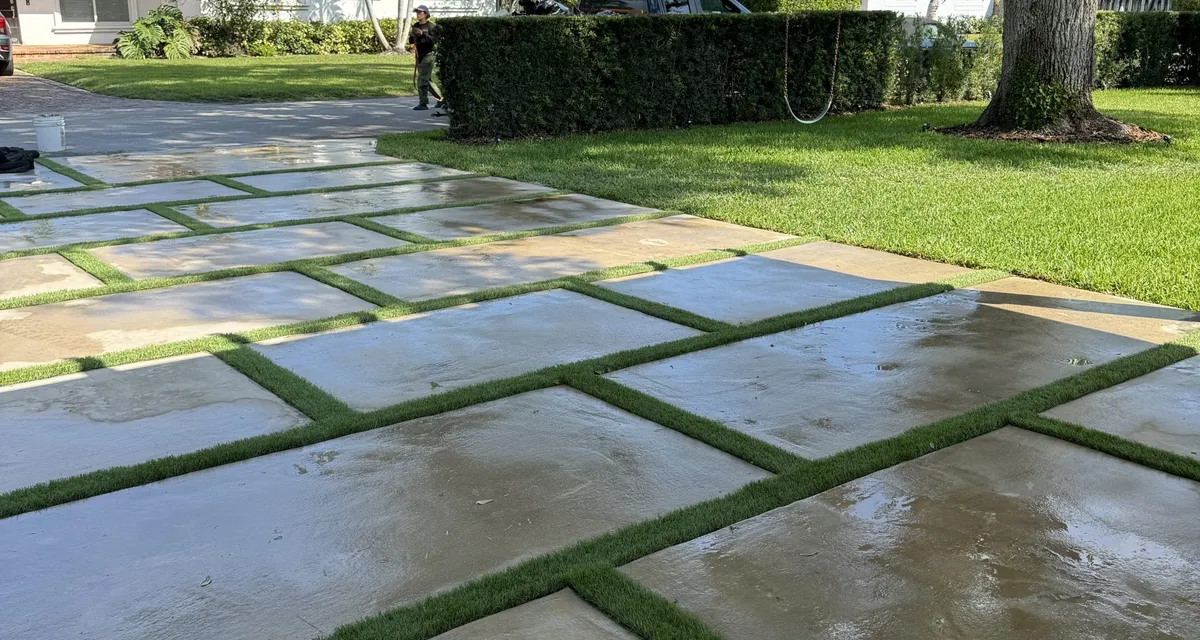
A self-storage facility’s landscaping has one job most other commercial properties don’t share: it has to look maintained from the road with almost nobody checking on it in person. These sites typically run lean - a part-time or remote manager, maybe a weekly drive-by from a regional supervisor - which means a street-facing lawn that depends on a mowing contractor showing up on schedule is exactly the kind of thing that slips. Commercial artificial turf has started showing up on self-storage properties across South Florida’s affluent corridor for that reason, and the decisions that go into a project like this come in a specific order.
Deciding what actually gets converted
The highway- or road-facing frontage comes first on almost every self-storage property, since it’s the only part of the lot most passersby ever see and the spot where a brown or weedy strip does the most damage to how the business reads from the street. After that, attention usually moves to medians between drive lanes and any planted border around the office or gate entrance - areas that are small individually but add up across a property that can run several acres. The drive lanes themselves, and any area a moving truck or trailer actually crosses, get evaluated separately, since those take a different build than anything judged purely on looks.
Deciding how the vehicle lanes get built
This is the step that trips up projects done without a commercial-grade spec. A frontage lawn or a planted median only has to carry foot traffic, so it uses the same base as a residential yard. A drive lane between unit buildings, or any spot a box truck or trailer might cross while a tenant loads a unit, needs a reinforced base built for that load - treating the two the same way is the most common reason a vehicle-crossing strip fails early while the frontage next to it holds up fine for years. Govorex flags which zones need which base during the initial site walk, before anything gets priced.
Deciding who needs to sign off
Self-storage properties don’t answer to an HOA board, but they almost always answer to someone. A franchise-branded location typically routes through the operator’s corporate real estate or facilities department, while an independently run facility near Pompano Beach or Coral Springs more often falls under a city’s commercial landscaping ordinance for street frontage. Govorex prepares the same material, drainage, and edging spec sheet either way, and the free on-site consultation is where that gets matched to whichever reviewer actually has to approve the job.
Deciding when it pays off
The math that convinces an operator usually isn’t the install price - it’s what stops showing up on the recurring budget afterward. No mowing contractor to schedule around tenant move-ins, no irrigation line to repair after a trailer backs over a sprinkler head, and no reseeding the same sun-scorched frontage strip every year. Facilities near Boca Raton and Delray Beach that had re-sodded the same visible strip more than once in a few years are typically the ones that call first, because the ongoing cost of keeping live grass looking presentable had already stopped making sense relative to how little anyone was there to maintain it.
Deciding how it gets paid for
Commercial turf at a self-storage property prices the same way residential work does - $6.99 per square foot installed as the starting rate, with the final number set by total square footage and whatever reinforced base the drive lanes need. An operator managing multiple locations across West Palm Beach and nearby markets can run each property as its own quote and its own schedule rather than committing to every site at once, and financing is available on the same 50%-down, 12-month, no-interest terms used for any Govorex project, subject to approval.
A facility manager who wants a real number can start with the instant quote tool for a square-footage ballpark, or see commercial artificial turf for the full scope of what’s included. Every Govorex project comes from a crew with 15+ years of experience, licensed and insured, with most frontage and border work finished inside the standard 48-hour install window.
Want your yard's real number? Outline it on a satellite map and see starting prices and a 12-month payment plan in about a minute — no sign-up.
Try the Instant Quote Calculator →