Commercial Turf for Private Schools in South Florida
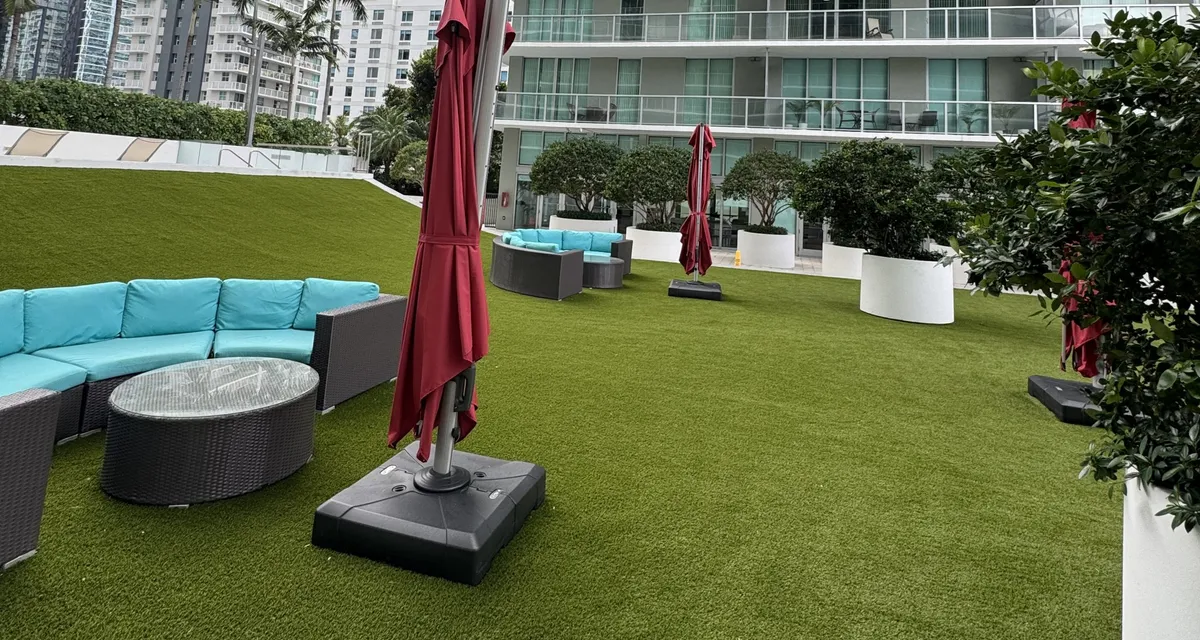
A private school campus rarely has one turf problem - it has three or four, scattered across a property that families and staff see every single day. The drop-off loop gets torn up by tires and foot traffic twice a day. The courtyard between buildings turns to mud after a rainy-season afternoon. A play strip behind the gym needs to hold up to recess without becoming a liability. Artificial turf solves each of those separately, which is why a commercial artificial turf plan for a school works best as a zone-by-zone map rather than one number for “the whole campus.” Administrators across Boca Raton, Wellington, and Parkland are increasingly asking Govorex for exactly that kind of plan instead of patching grass year after year.
| Campus zone | What wears it out | Turf approach |
|---|---|---|
| Entrance & drop-off loop | Daily tire traffic, foot traffic, standing water | Commercial-grade backing, reinforced base, firm edging |
| Courtyards & connector walkways | Shade, rain, constant foot traffic between classes | Residential-grade synthetic turf, ADA-compliant path edges |
| Play strips & PE space | Recess, running, fall risk | Fall-rated padded system, denser pile |
| Shared event lawn | Open houses, assemblies, graduation setup | Standard landscape turf, flat and uniform for seating |
The entrance and drop-off loop
The drop-off loop is the first and last thing every parent sees, twice a day, which is exactly why it’s usually the worst-looking grass on campus. Two drop-off windows a day, five days a week, wears a strip of real grass down to dirt within a semester, and whatever median or edge strip borders the loop takes the brunt of it. A commercial-grade turf build with a reinforced base holds up to that kind of concentrated, repeated traffic without the bare patches and mud that show up in every parent’s rearview mirror.
Courtyards, quads, and connector walkways
Between-building courtyards and the walkways connecting them see a different kind of wear - less vehicle traffic, more constant foot traffic, often under shade that keeps a natural lawn thin and patchy. Synthetic grass handles that shade problem turf was built for, staying dense and green in corners where real sod never quite fills in. Any walkway doubling as an accessible route also needs a firm, level surface and a clean transition at the edge, which Govorex builds into the base rather than treating as a separate project once the turf goes down.
Play areas without a separate playground project
A school with a dedicated play strip or recess lawn doesn’t need to run that as a disconnected project from the rest of the campus - the same crew specs a fall-rated padded system for that zone while building standard landscape turf everywhere else, all on one proposal and one schedule. The padding depth gets matched to the actual equipment on site rather than applied as one generic thickness campus-wide, the same approach Govorex uses on dedicated playground installs.
Scheduling around the school year, not the weather
Most homeowners plan turf installs around hurricane season or the rainy-season calendar; schools plan around the academic one instead. Summer break is the obvious window for a full-campus project, but a long weekend, a holiday recess, or simply working after dismissal covers a single zone without ever touching class time. Larger campuses often split the work into phases - the drop-off loop over one break, a courtyard the next - so no single closure has to cover the whole property at once.
Paying for a campus-wide project
A multi-zone campus project still runs on the same terms as a single backyard: half the total cost due when installation starts, the balance split evenly across 12 monthly payments with zero interest, subject to approval. Schools often use that structure to spread a project across two budget cycles rather than requesting one large lump sum, financing the drop-off loop and courtyards in one phase and the play area in a later one if that fits the calendar better.
What a quote for your campus actually includes
Every campus is laid out differently, so Govorex walks the property in person before pricing anything - measuring each zone, noting drainage and shade, and flagging where fire-lane or ADA requirements apply before a single square foot gets quoted. That walkthrough turns into one proposal covering every zone a school wants addressed, with commercial turf specs matched to how each space actually gets used. Start with a square-footage estimate from the instant quote tool, then confirm it on-site for an exact number.
Want your yard's real number? Outline it on a satellite map and see starting prices and a 12-month payment plan in about a minute — no sign-up.
Try the Instant Quote Calculator →