Commercial Turf for Daycares and Preschools
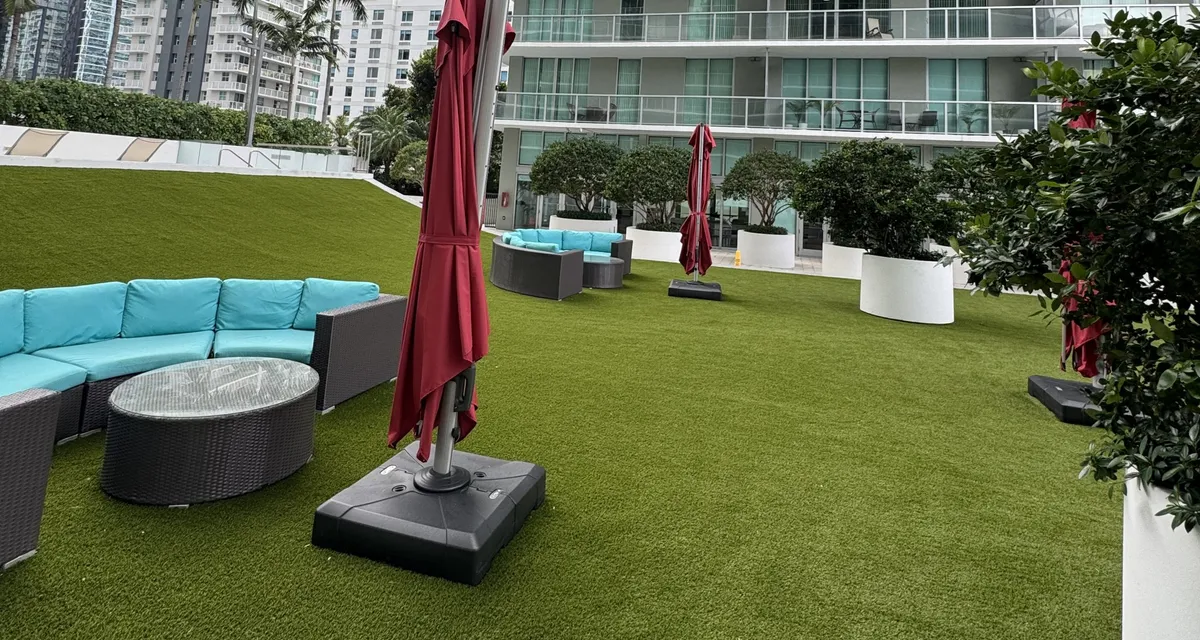
A daycare director replacing a play yard isn’t choosing between two lawns - she’s choosing between two different problems. Keep the mulch or pour-in-place surface the center already has, and the maintenance calls keep coming: mulch scattering past the fence line, bare patches opening up under the swing set, a surface that needs topping off every few months just to hold its depth. Switch to commercial artificial turf, and the problem changes shape entirely - now it’s a one-time decision about fall-height compliance, licensing sign-off, and how much the yard can afford to be closed. That’s the actual choice in front of most centers across Broward and Palm Beach County, and it’s worth walking through in the order it actually gets decided.
Patch the current surface, or replace it outright
The first fork in the road isn’t about turf at all - it’s whether the existing surface has gotten bad enough to justify replacing instead of repairing. Mulch and pour-in-place rubber both have a maintenance ceiling: past a certain point, topping off worn spots costs nearly as much per year as a synthetic turf system would cost once, without ever solving the underlying problem of a surface that degrades under constant foot traffic. Centers in Boca Raton and Wellington usually make the switch once they’ve run the repair-and-patch math for a season or two and found the number isn’t shrinking.
A play yard has to meet a fall-height number, not just look safe
This is where commercial play turf diverges from a standard lawn or courtyard install. Turf alone doesn’t satisfy a licensing inspection - the padded layer underneath does, and it has to be sized to the actual fall height of the equipment it’s protecting, not a generic depth pulled from a catalog. Govorex measures each piece of climbing or play equipment on site and specs the pad accordingly, the same way a playground install anywhere else in the service area gets built, just scaled to however many classrooms’ worth of equipment a center is running.
Weighing the upfront number against what the old surface already costs
Centers tend to budget turf like a renovation line item, but the more useful comparison is against what the current surface already costs every year - mulch deliveries, rubber top-offs, labor to rake and level after a storm. Artificial grass starts at the same $6.99 per square foot installed rate as any landscape job, with the padded play spec adding to that number, and most directors find the gap closes faster than expected once a year or two of surface upkeep gets factored in.
Timing the work so the center doesn’t lose outdoor days
A play yard that’s shut down for weeks isn’t a realistic option for a center running daily outdoor time, so scheduling matters as much as the spec. Govorex’s standard 48-hour install window fits inside a single scheduled closure or a weekend for most single-zone yards, and centers with more than one outdoor area - common in larger facilities near Parkland and Palm Beach Gardens - can phase the install zone by zone so somewhere stays open the whole time.
Getting the paperwork settled before the crew shows up
Most centers lease their building, which means a play-yard change usually needs sign-off from a landlord or property manager on top of whatever a county licensing review requires for the outdoor space. Rather than treating those as two separate approvals, Govorex puts together one spec sheet and a physical turf-and-pad sample that covers both - the same packet used for HOA and commercial reviews elsewhere - so a director isn’t stuck chasing two signatures on two different timelines.
Replacing a daycare or preschool play yard is a decision a director usually makes once and lives with for years, which makes getting the sequence right - compliance first, budget second, scheduling third - worth more than rushing to a number. Run the yard’s dimensions through the instant quote tool for a starting figure, or book a free on-site visit through commercial turf to get the fall-height spec and licensing paperwork sorted before committing to anything.
Want your yard's real number? Outline it on a satellite map and see starting prices and a 12-month payment plan in about a minute — no sign-up.
Try the Instant Quote Calculator →