Commercial Artificial Turf for South Florida Country Clubs
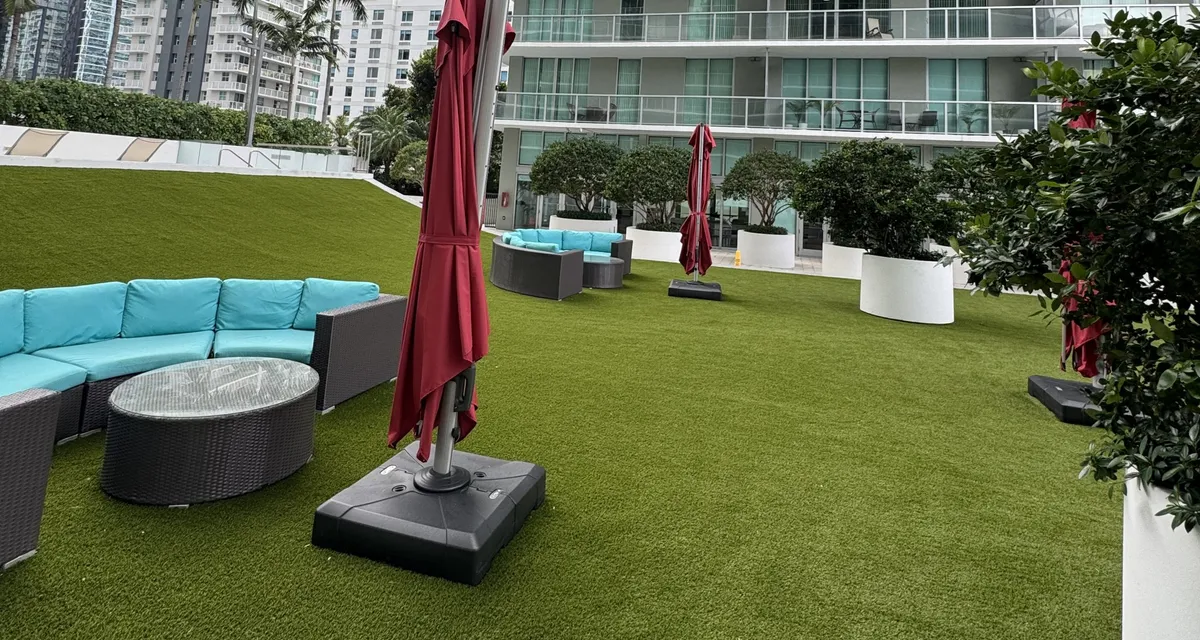
A country club’s grounds budget carries a different kind of pressure than a single homeowner’s lawn - the clubhouse entrance, the pool deck, the event lawn, and the strips along every cart path all have to look sharp for members every single day, not just the week before a tournament. That’s exactly where commercial artificial turf has started showing up across the gated communities and clubs scattered through South Florida’s affluent corridor, not on the fairways themselves, but on the shared spaces around them that take constant foot and cart traffic and never get a season off to recover. Here’s where it actually gets used on a club property, who has to approve it, and what a project like this costs.
Where Does Turf Actually Make Sense on a Club Property?
Not on the course itself - fairways and greens stay under the club’s own agronomy program, and that’s not a tradeoff Govorex is in the business of changing. The opportunity is everywhere around the playing surface: the clubhouse front lawn that every member and guest walks across, pool and cabana decking, member event lawns used for weddings and galas, and the edges of cart paths and parking islands that get driven and walked over hundreds of times a day. Those spots see more wear than almost anything else on the property, and synthetic grass holds a uniform, green finish through those traffic patterns in a way natural sod struggles to.
Who Signs Off on a Project Like This?
Usually a grounds committee or the general manager, working from the same kind of documentation a residential HOA board would ask a single homeowner for - a physical sample next to the existing landscaping standard, plus a written spec covering base depth, drainage, and edging detail. The difference is scale, not process: a club committee is signing off on shared property that every member sees, so Govorex builds that packet to show how the turf performs specifically in the areas under review, whether that’s a clubhouse lawn near Jupiter or a cart path edge in a Palm Beach Gardens community.
Does It Change How the Grounds Crew Spends Their Time?
It shifts where their time goes rather than eliminating the work. A club’s grounds staff keeps the course, the ornamental beds, and the trees exactly as they always have - what changes is that the clubhouse lawn, event space, and cart path edges stop needing the mowing and irrigation attention they used to get, freeing that crew time for the areas that still need a horticulturist’s eye rather than a mower. Clubs in Boca Raton and Wellington have used that freed-up time to tighten up seasonal color beds and course-adjacent landscaping instead.
What Happens to the Course-Facing Edge?
This is where the finish work matters most. Any turf area that borders a fairway, a tee box, or a practice green gets matched in pile height and color tone to the natural grass next to it, so the line between the two reads as a clean transition rather than a visibly different green rectangle. Grading on that edge is planned the same way it would be on a residential fairway-facing backyard - water moves away from the course side, not toward it - which matters just as much on a shared cart path strip as it does on a member’s own property.
What Does a Club-Scale Project Cost and How Long Does It Take?
The rate doesn’t change for commercial work - landscape turf still starts at $6.99 per square foot installed, with the final number driven by total square footage and whatever base reinforcement a specific area needs, like extra drainage under a cart path. Most residential-scale sections finish within Govorex’s standard 48-hour window, and a larger property with several distinct areas - clubhouse lawn, event lawn, cart path edges - typically gets scheduled as sequenced visits so the club never has more than one zone closed off at a time.
A club interested in seeing what this looks like on its own property can start with the instant quote tool for a square-footage ballpark, or see commercial artificial turf for the full scope of what’s included. Govorex also installs paver and turf strip combinations for cart paths and parking islands as part of the same visit. Every project comes from a crew with 15+ years of experience, licensed and insured, serving clubs and HOAs across Broward and Palm Beach County, with financing available at 50% down and 12 no-interest monthly payments, subject to approval.
Want your yard's real number? Outline it on a satellite map and see starting prices and a 12-month payment plan in about a minute — no sign-up.
Try the Instant Quote Calculator →