Artificial Turf for Golf Cart Pads in South Florida
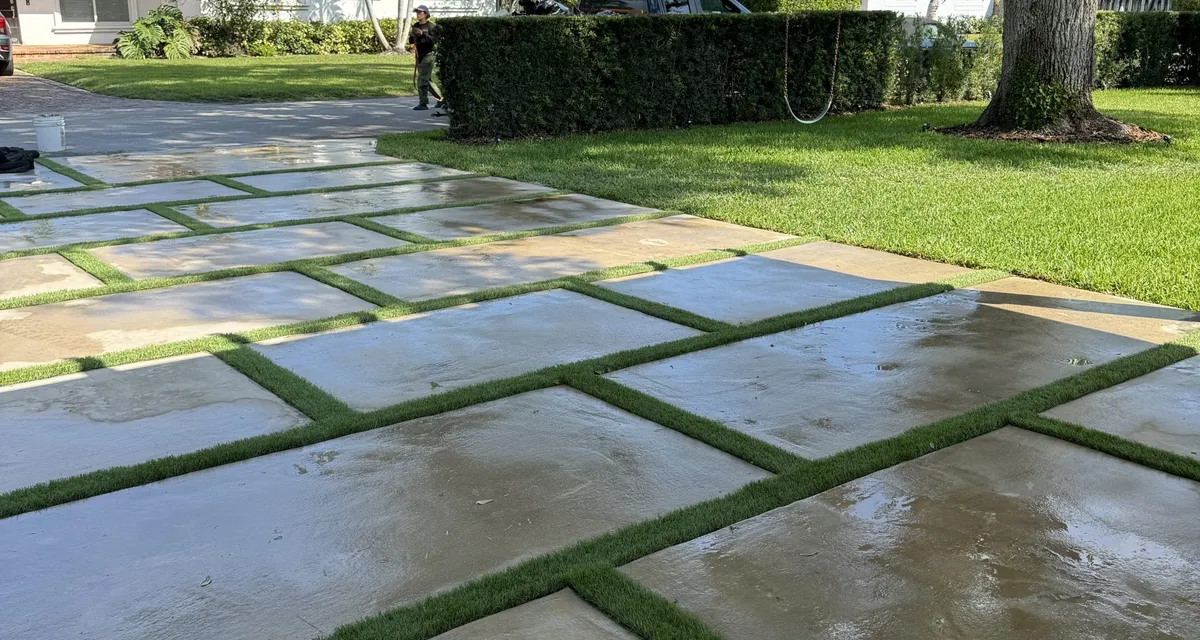
Drive through one of the golf-cart-friendly communities that run from Wellington up through Palm Beach Gardens on a weekday afternoon, and the cart barn door is usually propped open, with the cart backed halfway out onto a strip of ground that gets more daily traffic than the rest of the yard combined. That apron - the few feet between the barn or garage and the community’s cart path - is one of the most-used patches of ground on the whole property, and it’s often the one that got the least thought when the lot was originally landscaped. Artificial turf has become the default fix for it across the corridor, not because the look matters more there than elsewhere, but because that spot wears out real grass faster than almost anything else on the lot.
A patch of ground that works harder than it looks
The apron outside a cart barn isn’t a lawn in the usual sense - it’s a turning and staging area that gets used every time the cart comes in or out, which in a lot of these households means several trips a day. Natural grass in that exact footprint thins out fast, not from foot traffic but from the same tight pivot happening in the same few square feet day after day, and what’s left behind is usually a bare, rutted patch right where guests and golf partners see it first. Synthetic turf holds up differently in that spot because it isn’t trying to regrow between uses the way living grass is - it just needs to be specified for the actual motion happening on top of it.
Building the apron for how a cart actually moves
A cart’s turning radius is tighter and more repetitive than a car’s, so the pivot zone right at the barn opening gets a denser pile and a more heavily compacted base than the rest of a typical lawn conversion - the same logic Govorex applies to a driveway’s turf strips, just concentrated into a smaller, harder-working footprint. Past that pivot point, where the cart is simply rolling straight down the path to the community’s cart network, a standard landscape-grade spec is usually enough. Treating the whole apron as one uniform lawn is where most DIY attempts at this go wrong; building it in zones is what makes it last.
Keeping water moving under a covered barn
A lot of cart barns in Wellington and Palm Beach Gardens sit under an overhang or an extension of the roofline, which actually helps the apron underneath rather than hurting it - less direct rain means less standing water to manage day to day. The detail that does need attention is the roof’s own runoff line, since a downspout or roof edge dumping straight onto one spot in the turf can undo a clean install if it isn’t routed into the same drainage path the rest of the property already relies on. That gets mapped out at the site visit, before any base goes down, not fixed after the fact.
Where this sits inside a golf community’s design rules
Golf communities tend to have their own architectural standards for anything visible from the street or a neighboring cart path, and an apron next to a barn generally gets reviewed the same way a front lawn would - against a sample and a written spec rather than a judgment call on the material itself. Govorex has carried that same documentation into board reviews for properties in Boca Raton and Delray Beach country club communities, and the process tends to move fastest when the apron and any adjoining turf area are presented as one coordinated project instead of two separate requests filed months apart. Communities around Jupiter’s cart-friendly neighborhoods see the same pattern.
Pricing it against the rest of the property
Turf around a cart pad runs on Govorex’s standard residential rate, starting at $6.99 per square foot installed, and because the apron itself is usually a small, defined area rather than an open yard, the total for that piece of the project tends to be modest - even when the denser pivot-zone spec adds a bit to the square-foot number right at the barn opening. Most installs, apron included, still finish inside Govorex’s standard 48-hour window, and it’s common for a cart pad apron to get scheduled alongside a larger front-lawn or driveway turf strip project on the same visit rather than booked separately. Anyone with a rough measurement in hand can start with the instant quote tool for a starting number before the free on-site consultation locks in the real one.
Govorex has specified ground cover for this exact zone - and the fairway-facing lawns around it - across golf communities in Wellington, Palm Beach Gardens, Boca Raton, and Delray Beach for 15-plus years, with every crew licensed and insured for the work. If the lot also has a fairway view to account for, the full breakdown lives in Govorex’s guide to turf in golf communities; if the barn sits near an EV charger too, the layout considerations for that pairing are covered in the EV charging pad guide.
Want your yard's real number? Outline it on a satellite map and see starting prices and a 12-month payment plan in about a minute — no sign-up.
Try the Instant Quote Calculator →