Artificial Turf Around Home Generators in South Florida
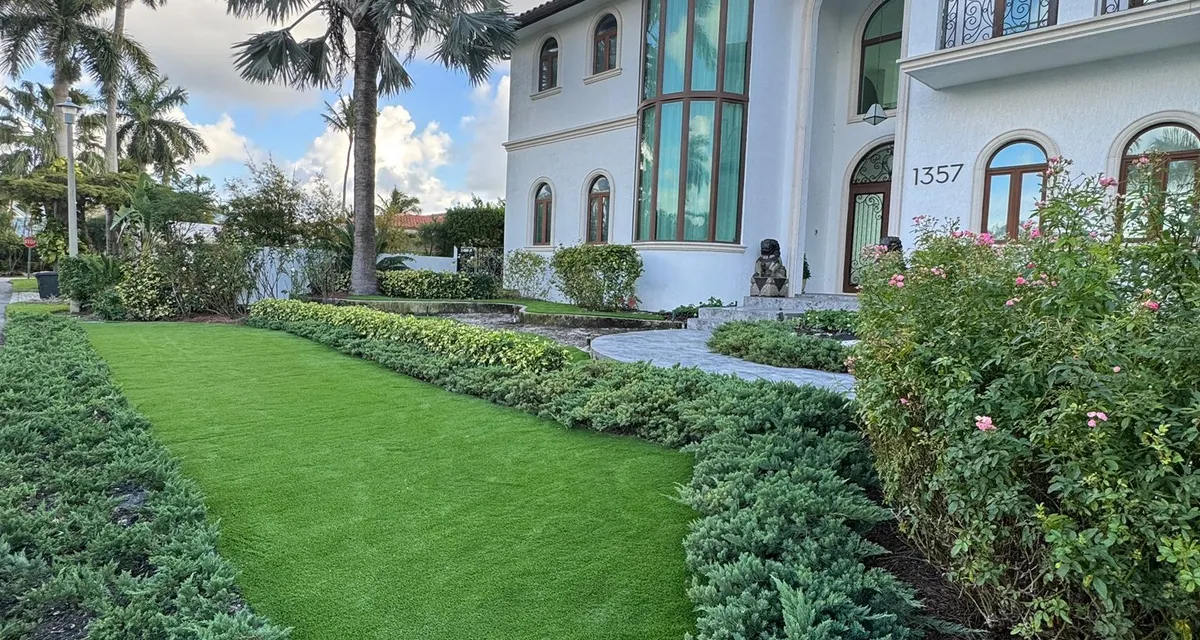
Whole-home standby generators have gone from a luxury add-on to something close to standard equipment across Broward and Palm Beach County, and every one of them needs a flat concrete pad plus a plan for whatever covers the ground around it. That’s turned into a small but recurring request for Govorex: once the generator installer pours the pad and runs the gas line, the property owner is left staring at a patch of dirt, gravel, or struggling sod along a side yard or fence line that the lawn crew can never quite get a mower blade into cleanly. Artificial turf solves that the same way it solves any awkward strip too tight for routine lawn care - with a few generator-specific rules that don’t apply to a typical side yard.
The three things people try first, and why they don’t hold up
Bare dirt around a pad erodes fast, especially with a downspout or AC condensate line draining nearby, and it turns to standing mud after a summer storm. Pea gravel looks tidy on day one but migrates into the grass beyond its border within a season, and it gives a mower nothing but rocks to kick up if anyone tries to maintain the edge. Sod planted tight against a concrete pad in a shaded side-yard strip usually thins out within a year - not enough sun, not enough airflow, and a mower that can’t get close enough to cut it evenly. Synthetic grass skips all three problems: no erosion, nothing loose to migrate, and no sunlight requirement to fail.
The clearance zone comes before any landscaping decision
Every generator manufacturer specifies a minimum clearance around the unit, particularly on the exhaust side, for anything combustible - and that distance governs the layout before turf, pavers, or anything else gets planned. Govorex’s site visit starts by confirming exactly where that line falls for the installed unit, then plans the turf to stop short of it. On the three sides that don’t carry exhaust heat, turf can usually run right up to the housing; the exhaust side typically gets a paver apron or decorative stone instead, so the finished area still looks intentional rather than unfinished.
Fitting turf to a pad that’s already in the ground
A generator pad is poured concrete, which means its edge is a fixed, hard boundary the same way a pool deck or a paver walkway is. Govorex grades the sub-base flush to that edge so water draining off the pad doesn’t pool against the turf, then cuts the turf tight to the concrete line rather than leaving a gap that weeds or loose edging would eventually find. Properties in Weston and Fort Lauderdale with generators tucked into a narrow side yard see this most often - the pad sits a few feet off the house, and the strip between it and the fence line is exactly the kind of space synthetic turf was built to cover.
Getting it past a board without a second meeting
A generator installation on its own already goes through plenty of review in most communities, and the ground cover around it typically gets folded into that same conversation rather than treated separately. Associations in Boca Raton and gated communities near Palm Beach Gardens generally want the same things for any turf request - a sense of how the material looks from outside the lot and confirmation it meets the community’s standard. Govorex prepares the same spec sheet and physical sample used for a full-yard approval, scoped down to the pad’s footprint, so there’s nothing left to resolve once the generator itself is approved.
What it costs and how it gets paid for
Residential artificial grass starts at $6.99 per square foot installed, and because a generator surround is almost always a narrow strip rather than open acreage, the total project cost tends to land on the lower end - the exact figure comes from measuring the pad’s actual footprint at a free on-site consultation. Financing follows Govorex’s standard structure regardless of project size: 50% down when installation begins, the remaining balance divided evenly across 12 monthly payments, no interest added, subject to approval. Most installs, generator surrounds included, finish inside the standard 48-hour window. Anyone with a pad already poured who wants real numbers can start with an instant quote, and anyone still planning the broader yard around it should look at Govorex’s guide to artificial turf around AC units for how a similar utility-equipment strip gets handled elsewhere on the property.
Want your yard's real number? Outline it on a satellite map and see starting prices and a 12-month payment plan in about a minute — no sign-up.
Try the Instant Quote Calculator →