How Artificial Turf Seams Work in South Florida
Every artificial grass lawn wider than a single roll of turf - which is most of them - needs at least one seam, and how that seam is cut and joined is the difference between a lawn that looks poured in one piece and one with a visible line running through it. Homeowners researching artificial turf installation in Broward and Palm Beach County rarely ask about seams up front, but it’s one of the details that separates a professional synthetic grass install from a rushed one. Here’s what actually happens where two pieces of turf meet.
Why almost every yard needs a seam in the first place
Artificial turf ships in rolls roughly 15 feet wide, and very few residential lawns are narrower than that in every direction. A backyard that’s 30 feet deep needs at least one seam to cover it edge to edge, and an L-shaped or irregular lot - common on corner lots and pool-adjacent yards across the region - often needs several. The goal isn’t zero seams; it’s seams a homeowner never notices once the lawn is finished.
What a seam actually is, step by step
A seam starts with the cut, not the glue. The installer trims both roll edges along the same row of stitching in the turf backing so the two pieces knit together without a gap or an overlap, then checks that the blade direction and pile height line up before anything gets joined. A strip of seaming tape goes down underneath the two edges, a bead of polyurethane adhesive bonds the tape to the turf backing, and the joint gets weighted while it cures. The last step - brushing the blades across the seam line once it sets - is what makes the joint disappear visually, since it blends fibers from both pieces instead of leaving a hard edge.
Where seams get placed, and why it’s planned before cutting
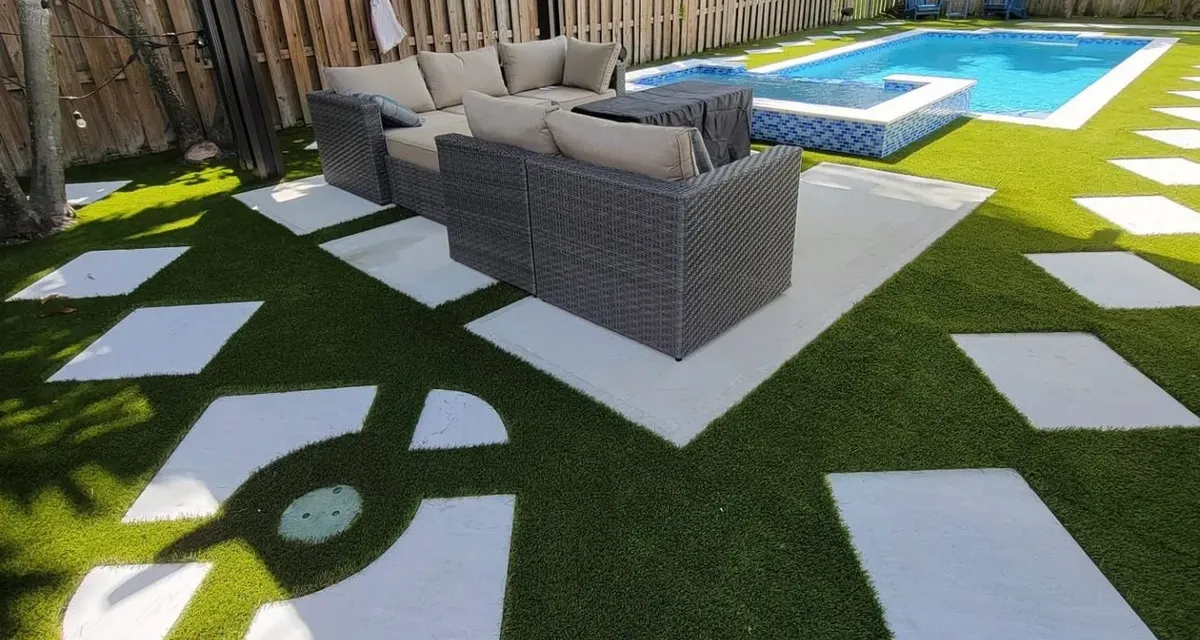
A seam running down the middle of an open lawn is the most visible place it could go, so experienced crews route seam lines along natural break points instead - next to a paver walkway, along a planting bed edge, or under a piece of furniture that sits in the same spot year-round. That planning happens before a single piece of turf gets cut, using the yard’s actual layout rather than the most efficient use of roll material. It’s a step homeowners in Southwest Ranches and Lighthouse Point, where lot shapes tend to be larger and less uniform, benefit from directly - more seams to plan around, and more reasons to place them carefully.
How South Florida’s climate factors into seam durability
Turf backing expands and contracts with temperature the way most materials do, and Broward and Palm Beach County push that cycle harder than a milder climate would - a lawn can swing from cool overnight to well over 100 degrees at the surface by early afternoon. Heavy rain adds a second factor, since a seam has to stay bonded even as water moves through the base underneath it during a wet-season downpour. The adhesive Govorex uses is rated for exactly that swing, and giving a seam proper cure time before backfilling with infill is what keeps it from ever becoming the weak point in an otherwise solid lawn.
What it means for your installation
None of this changes what a turf project costs to quote or how it gets paid for - it changes how the crew plans the layout once they’re on-site. Yards near Boynton Beach with pool decks or multiple planting beds often end up with three or four seams by the time the layout is mapped, while a simple rectangular front lawn might need only one. Either way, landscape turf starts at $6.99 per square foot fully installed, financing splits into 12 equal monthly payments with 50% down and no interest, and most installs - seams included - are finished inside 48 hours. The instant quote calculator gives a starting estimate from a satellite photo, and the free on-site consultation is where the actual seam layout gets planned for residential artificial grass before any turf gets cut. For more on what shapes the final number, see how artificial turf infill types and comparing turf quotes round out the rest of the installation.
Want your yard's real number? Outline it on a satellite map and see starting prices and a 12-month payment plan in about a minute — no sign-up.
Try the Instant Quote Calculator →