Commercial Artificial Turf for South Florida Churches
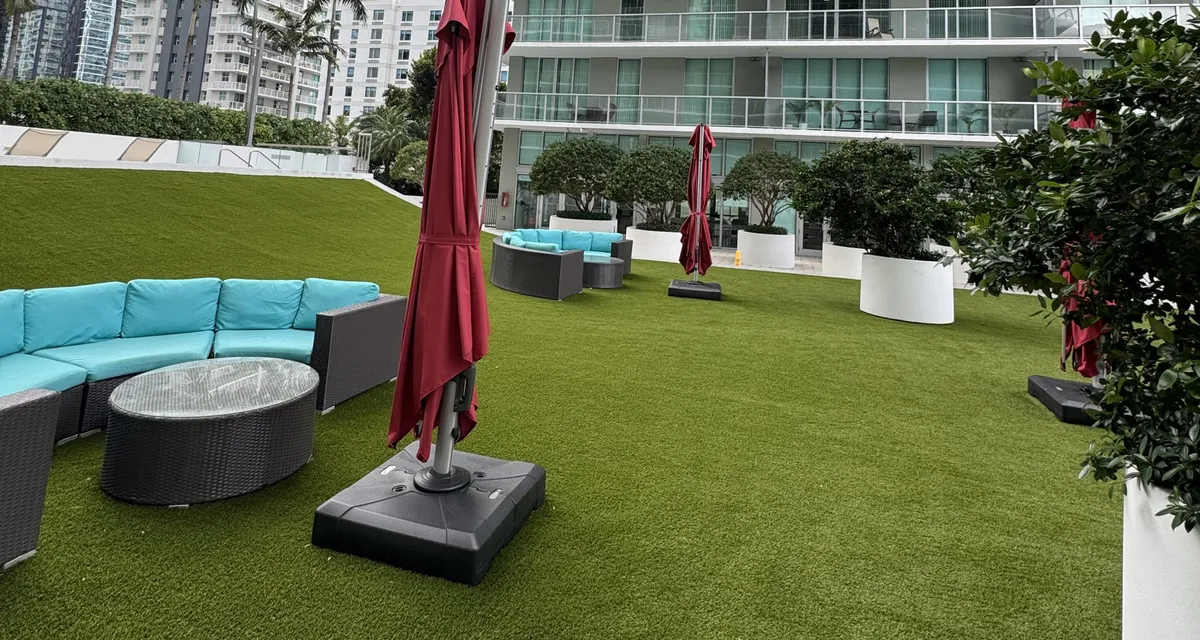
A church, synagogue, or community center rarely has a grounds problem seven days a week - it has one specific problem on the days the parking lot fills up. That’s the pattern that makes commercial artificial turf worth a look for a campus in a way it isn’t quite the same conversation as a homeowner’s backyard: the grass has to survive a packed Sunday morning or a Saturday program, then sit mostly unused until the next one, and natural grass handles that boom-and-quiet cycle badly. Facilities committees across Broward and Palm Beach County have started asking Govorex the same set of questions before committing to synthetic turf on a campus that isn’t a private home.
What makes a house of worship or community center different from a typical commercial job?
A retail strip or an office park gets steady, spread-out foot traffic all week. A congregation’s grounds get the opposite - a burst of people crossing the same courtyard and lawn strip within a two-hour window, then almost nobody until the next scheduled gathering. Natural grass thins out fast along whatever path that crowd actually takes, even while the rest of the lawn stays fine, because the wear concentrates instead of spreading out. Artificial grass doesn’t care whether three hundred people cross it at once or nobody does - the fiber holds up the same either way, which matters more here than on almost any other type of commercial property.
Which parts of a campus actually benefit from turf?
Not every square foot of a church or community center’s grounds needs the same treatment, and most facilities directors end up prioritizing four areas: the entry courtyard where people gather before and after a service, a fellowship or event lawn used for cookouts and outdoor programming, any playground tied to a children’s ministry or after-school program, and the transition strip between the parking lot and the building where shade from the structure and heavy pedestrian crossing keep live grass thin no matter how it’s irrigated. A campus near Boca Raton with a large open lawn behind the sanctuary is a different project than a smaller property in Delray Beach that mostly needs the entry walk and a playground handled - the same way playground turf gets specified differently for a fall-safety area than an open lawn does.
What does it cost for a facility this size?
Pricing follows the same structure as any Govorex project: landscape-grade commercial turf starts at $6.99 per square foot installed, and the final number moves depending on how much of the campus is being converted, whether a padded playground base is part of the scope, and what drainage work the site needs. A single entry courtyard prices very differently than a full grounds conversion, which is why Govorex walks the property first rather than quoting a per-square-foot number over the phone for a site nobody’s seen.
Will zoning or a landscape review slow anything down?
Most municipalities in the corridor from Fort Lauderdale north through Palm Beach island treat a turf conversion on a nonprofit or religious property the same way they’d treat it on a commercial lot - a landscaping change reviewed against a site plan, not a structural permit process. Committees managing property near Wellington and similar communities have found the review moves faster than expected once a sample board and drainage plan are already in hand, which is the same package Govorex prepares for any commercial client before the conversation with a building department or facilities board even starts.
What happens to Sunday service or a scheduled program during installation?
Nothing has to stop for it. A single courtyard or lawn section typically finishes inside Govorex’s standard 48-hour window, and a larger, multi-area campus gets phased so the sections still in use stay open while crews work elsewhere on the property. Installation gets scheduled around the week’s service and program calendar rather than the other way around - a detail that matters more to a facilities committee than it ever does to a homeowner picking a random Tuesday.
Getting a number for your campus
Every church, synagogue, and community center grounds is laid out differently, so Govorex prices these the same way it prices any commercial property - after walking the site, not off a flat estimate. Start with the instant quote tool for a ballpark figure, then book a free on-site consultation where a facilities committee can review samples and a proposed site plan together. Govorex brings the same 15+ years of experience, licensed and insured crews, and no-interest financing to a congregation’s grounds as it does to any commercial turf property across Broward and Palm Beach County, including the areas already covered in our guide to commercial turf for HOAs and property managers.
Want your yard's real number? Outline it on a satellite map and see starting prices and a 12-month payment plan in about a minute — no sign-up.
Try the Instant Quote Calculator →