Artificial Turf for RV and Boat Parking Pads
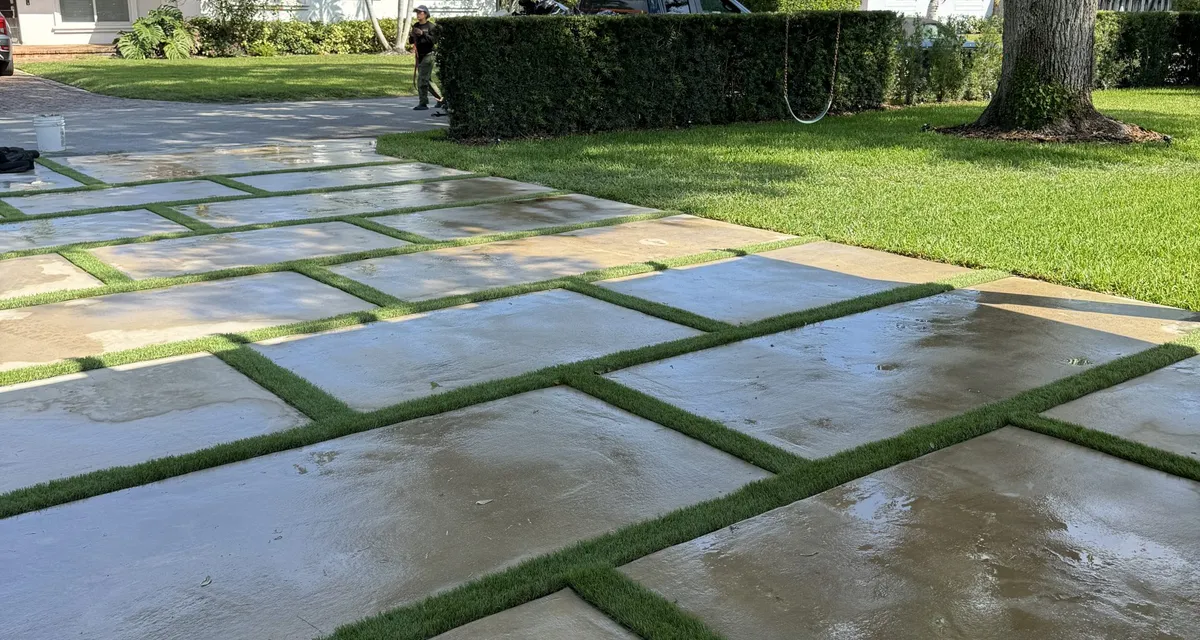
A boat trailer parked in the same spot for a season leaves a dead, compacted rectangle behind - no amount of watering brings that patch of lawn back, and by year two it’s just mud when it rains and dust when it doesn’t. The same thing happens under an RV parked between trips, or a work trailer that sits in a side yard more than it’s hitched up. Homeowners across Fort Lauderdale and Weston keep running into the same problem: the vehicle isn’t going anywhere, but the grass under it can’t survive being a parking spot. Artificial turf solves that, provided the pad underneath it is built for what’s actually going to sit on it.
Where the grass always loses
A lawn is built to recover between uses - foot traffic compacts it, but rain and mowing let it bounce back. A parking spot never gets that recovery window. The same tires or leveling jacks sit on the same few square feet for weeks or months at a stretch, and standard sod simply can’t survive that kind of static load. Synthetic turf doesn’t need to recover the way grass does, which is what makes it the more practical surface for a spot that’s functioning as parking, not lawn.
Matching the base to what’s parking on it
This is where a parking pad diverges most from a standard turf lawn. A backyard installation needs a base that drains well and supports foot traffic; a pad holding a boat trailer or a Class A motorhome needs a compacted, engineered sub-base rated for that weight, sized to the vehicle rather than a generic driveway spec. Get that step wrong and the turf itself is never the problem - the ground underneath settles, and low spots or ruts show up right where the tires sit. Get it right, and the surface holds its shape the same way a well-built driveway does.
The HOA question boards ask first
Boards near Lighthouse Point and Parkland are used to reviewing boat and RV storage requests, and most of them focus on the same things: how visible the vehicle is from the street, whether the pad is a defined, edged surface or an ad-hoc gravel patch, and how the whole setup reads next to the rest of the property. A turf pad with clean edging generally reads as an upgrade rather than a workaround, which is why Govorex prepares the same spec sheet and sample packet for a parking pad submission that it does for a standard yard conversion.
What it costs to build
Landscape-grade artificial grass starts at $6.99 per square foot installed, the same rate as any residential lawn - what changes for a parking pad is the site work underneath it. A reinforced sub-base built for vehicle weight, plus any regrading the spot needs, gets scoped at a free on-site consultation once Govorex sees the soil and the size of what’s parking there. A short trailer spot and a full RV bay aren’t priced the same way, since the base engineering scales with the load.
Keeping it clean between trips
There’s no mowing or irrigation to worry about once the pad is in, just an occasional rinse to clear road grime, leaves, or the odd oil drip - the permeable backing lets liquid pass through instead of pooling or staining the way it would on concrete. It’s a lower-maintenance surface than gravel, which tends to migrate and needs periodic top-offs, or bare dirt, which turns to mud in a summer storm.
Getting a plan for your pad
Every parking pad starts with a site visit, since soil condition and vehicle size both drive the base spec more than square footage alone. Govorex’s work on paver and turf strip driveways covers the same base-engineering approach used under a parking pad, and the instant quote tool gives a rough starting number before that consultation. Every installation comes from a crew with 15+ years of experience, licensed and insured, serving Broward and Palm Beach County, with most projects finished within 48 hours and financing available at 50% down and 12 equal monthly payments, no interest, subject to approval.
Want your yard's real number? Outline it on a satellite map and see starting prices and a 12-month payment plan in about a minute — no sign-up.
Try the Instant Quote Calculator →