Artificial Grass Around Solar Panels in South Florida
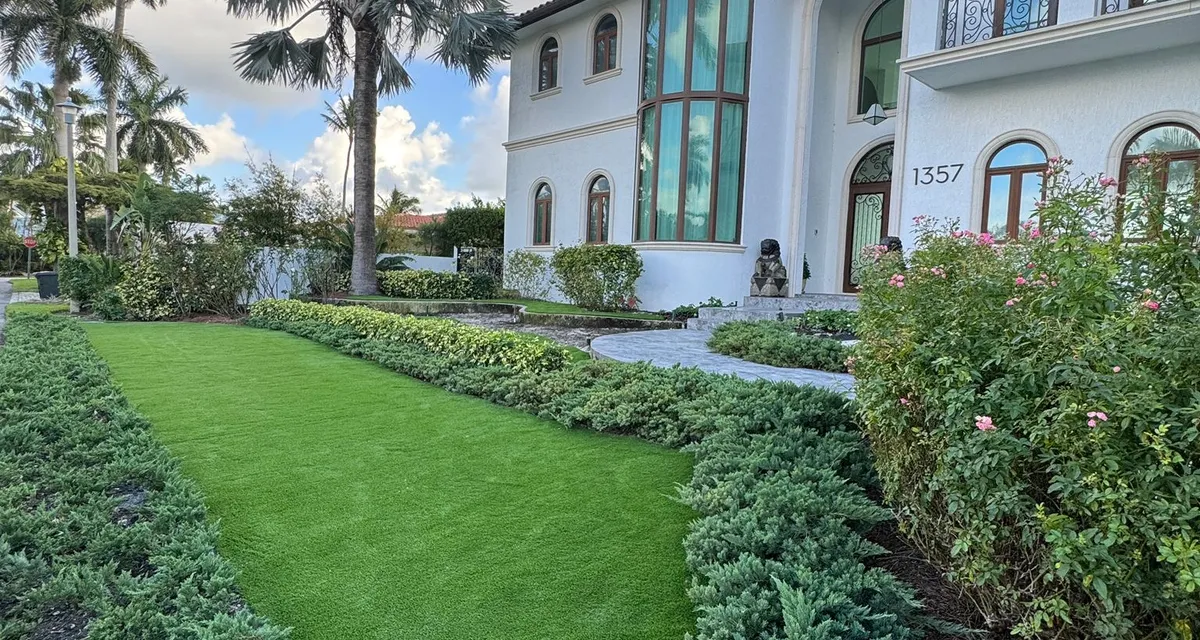
A ground-mounted solar array solves one utility bill and creates a smaller, more annoying problem right away: the ground underneath and around it still needs to be maintained, and a mower doesn’t fit well between low panel rows and support footings. Homeowners across Broward and Palm Beach County adding ground-mount solar - as opposed to a roof array, which leaves the yard untouched - run into this within the first season, usually right when the grass under the array starts thinning from the shade the panels cast and the strip around it gets scalped unevenly by a trimmer instead of a mower deck. Artificial turf removes both problems at once, which is why it’s become a common add-on request once a solar quote is already on the table.
The maintenance problem a mowed lawn creates once panels are up
A ground-mount rack is usually set a few feet off the grade, high enough to clear the panels but low enough that a standard mower can’t roll underneath it. What’s left is hand-trimming a strip of grass in tight, shaded rows every two weeks - exactly the kind of upkeep most homeowners installed solar to simplify their property, not add to it. Synthetic grass needs no mowing at all, so the strip under and between rows looks the same in month twelve as it did on install day, without a crew working around support legs with a string trimmer every visit.
Why the grass underneath struggles even with regular care
Panels cast a moving shadow pattern that shifts through the day, and most warm-season sod - St. Augustine especially - thins under that kind of partial, repeated shade faster than it would under a tree’s steadier canopy. The result is usually a patchy strip that never fully fills back in no matter how it’s watered or fertilized, because the shade pattern resets the recovery every time it starts to come back. Turf doesn’t need sun to stay full and even, so the ground under a rack looks identical to the open lawn around it.
Adding turf to a yard that already has the array installed
Most projects run in this order - solar first, landscaping decision second - rather than planning a yard around panels that haven’t been racked yet. Govorex builds the turf base around existing footings instead of requiring any part of the array to come out, and a site visit maps exactly how tight the rows are before the crew schedules the work. A side yard near Boca Raton with a single compact rack is a different job than a larger array spread across open ground near Wellington, but both follow the same approach: work the base around what’s already there.
What changes about access and upkeep afterward
Firm, compacted ground under turf is actually easier to work on than bare dirt or thinning grass when a solar installer comes back for a cleaning or a repair - no mud after rain, no uneven footing for a ladder. The only coordination point is low-voltage wiring or grounding conductors that sometimes run at grade between rows; flagging those locations before installation lets the crew route the base and seams around them rather than over them.
Where this fits in the budget next to a solar project
Turf around a rack prices the same way any residential lawn does - landscape-grade turf starting at $6.99 per square foot installed - and most arrays sit on open, regularly shaped ground that’s straightforward to spec once the footings are mapped. Homeowners near Jupiter often fold both projects into one financing conversation even though they’re billed separately, since Govorex’s standard terms - 50% down, the balance split across 12 equal monthly payments, no interest, subject to approval - apply to a turf project on its own.
Getting both pieces planned together
A free on-site consultation covers the array footprint and the rest of the yard in the same visit, so the turf plan accounts for footings, wiring, and row spacing instead of treating the panel area as an afterthought. The instant quote tool gives a starting number before that visit, and every Govorex install comes from a crew with 15+ years of experience, licensed and insured, with most yards finished within 48 hours once the plan is set.
Want your yard's real number? Outline it on a satellite map and see starting prices and a 12-month payment plan in about a minute — no sign-up.
Try the Instant Quote Calculator →