Artificial Grass for Shaded Yards in South Florida
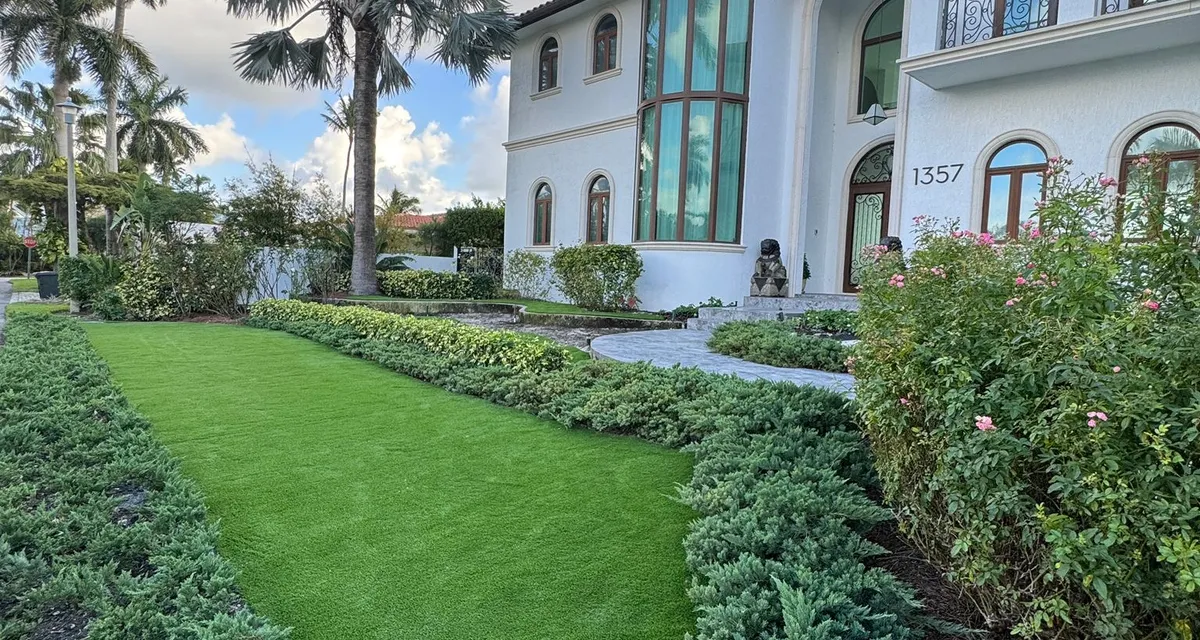
A backyard along one of Fort Lauderdale’s older, tree-lined streets tells a story Govorex crews see on repeat: three reseeds of St. Augustine in four years, all thinning out under the same canopy of mature live oaks, until the spot under the branches turned to bare dirt and mud after every rain. Artificial grass for shaded yards solves a problem sod was never built to solve - real turfgrass needs direct sun to photosynthesize, and a dense oak, mahogany, or banyan canopy common across Broward and Palm Beach County blocks exactly the light a lawn needs to stay thick. Synthetic turf carries no such requirement, which is why a shaded yard is one of the most common reasons South Florida homeowners finally make the switch.
Why sod struggles under a live oak canopy
Grass is a plant, and a plant starved of light thins from the roots up long before it looks obviously dead. A mature oak canopy can block 70% or more of direct sun from the ground underneath it, and South Florida’s canopies tend to be broad and evergreen rather than seasonal, so there’s no winter reprieve where more light reaches the lawn. Add root competition for water and nutrients - a live oak’s root system pulls hard from the same soil a lawn is trying to establish in - and most shaded turfgrass never gets past a patchy, moss-edged compromise no amount of fertilizer fixes.
The point most homeowners reach before calling
The pattern is almost always the same: a first reseed with regular sod, a second attempt with a shade-tolerant variety after the first fails, and by the third round of dead patches and standing mud, the yard gets written off as “just the shady part” that never really works. That’s usually the point a homeowner starts asking whether synthetic grass handles a canopy any better - and it does, because the one input real grass can’t do without is the one thing artificial turf never needed in the first place.
What changes once synthetic turf goes in
A shaded lawn installed in synthetic turf looks identical to a sunny one the day it goes in and stays that way - no thin spots forming under the heaviest branches, no seasonal dieback as the canopy fills in through spring growth. The only real difference sunlight makes to turf is surface temperature, and a shaded lawn actually runs cooler underfoot in the afternoon than turf in direct sun, which is a bonus rather than a tradeoff for anyone who found this article looking for a downside.
Installing turf around roots, canopy, and leaf drop
The install itself is where a shaded yard takes real planning. Govorex crews grade the base around exposed root flares instead of cutting through them, since a healthy mature tree is worth protecting and its roots don’t need to be leveled for turf to lie flat. Leaf litter from an oak or mahogany canopy sits on top of synthetic blades rather than matting into soil the way it does on sod, so a leaf blower or a garden hose clears it in minutes instead of a season of raking. Homeowners near Fort Lauderdale and Delray Beach, where older neighborhoods carry decades-old canopy trees, are where Govorex sees this exact combination most often - a beautiful, established tree and a lawn that’s given up trying to grow underneath it.
What it costs to convert a shaded yard
Shade doesn’t change the starting rate. Landscape turf begins at $6.99 per square foot fully installed, the same rate quoted for a full-sun front lawn, since the difference between a shaded install and a standard one is in how the crew works around roots and canopy drip lines - not in the turf product itself. A free on-site consultation is where that root layout gets mapped and the final number gets set, whether the yard is in Boca Raton or anywhere else in the service area.
Paying for it, and what comes next
Financing works the same regardless of why a lawn is being replaced: half down when the crew starts, the remaining balance split evenly across 12 monthly payments, and no interest added to the total, subject to approval. A yard that’s failed under a canopy for years qualifies for the exact same terms as any other project. Start with the instant quote calculator for a satellite-based estimate, then book the free consultation where Govorex walks the property, maps the root system, and prices the residential artificial grass install for the actual yard - not a guess made from the driveway. Every install comes from a crew with 15+ years of experience, licensed and insured, with most shaded-yard projects still finished inside a 48-hour window.
Want your yard's real number? Outline it on a satellite map and see starting prices and a 12-month payment plan in about a minute — no sign-up.
Try the Instant Quote Calculator →