Does Artificial Grass Survive Hurricanes in Florida?
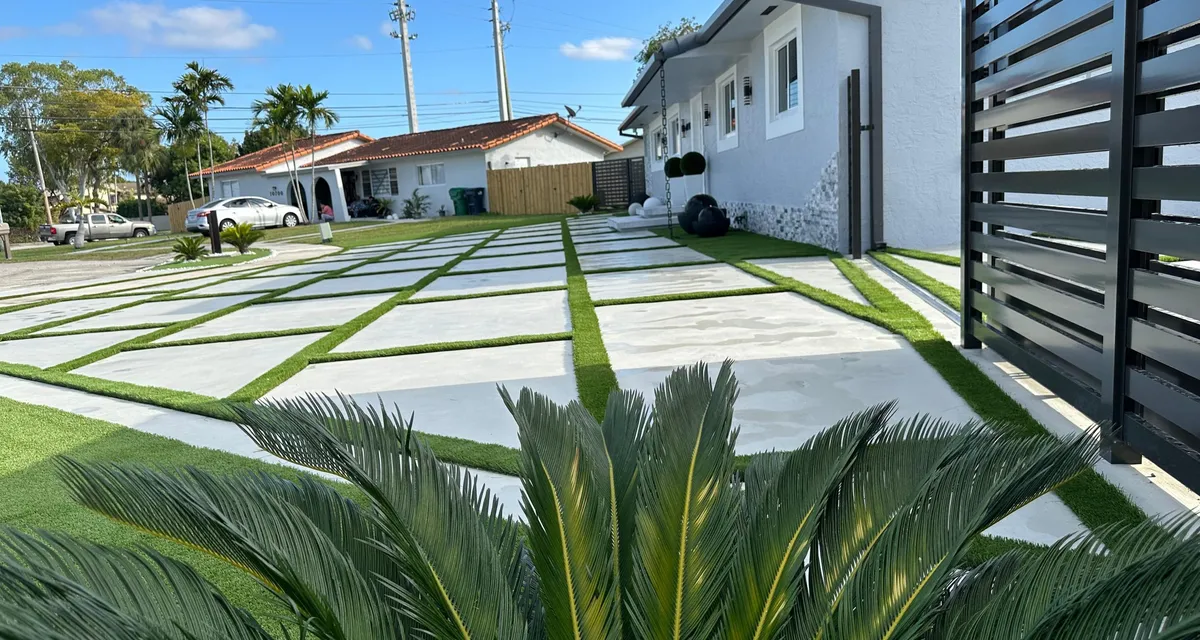
Does artificial grass survive hurricanes? Yes — a professionally installed synthetic lawn is anchored into a compacted, free-draining base and secured around every edge, so it stays put through the wind and water that tear real sod apart. In South Florida, where hurricane season runs June through November, that resilience is one of the quietest reasons homeowners across Broward and Palm Beach County make the switch to artificial turf. Here’s exactly why a good install holds up when the storm rolls through — and where cheap installs fail.
Why properly installed turf stays put
Loose landscaping is what a hurricane carries away: mulch, gravel, potted plants, and freshly laid sod that hasn’t rooted. Artificial grass is different because it isn’t sitting loose on the surface. A correct install is:
- Nailed and edge-secured — the turf is fastened into the ground and seamed tight around every border, driveway, and walkway, with no loose corner for wind to grab.
- Locked to a compacted base — several inches of crushed stone are graded and compacted underneath, so the whole system behaves like part of the ground, not a rug laid on top of it.
- Weighted by infill — the sand or specialty infill brushed into the fibers adds ballast that helps the blades stand and the surface stay flat.
That combination is why synthetic turf rides out a storm that strips a loose bark bed off the same yard.
Water is the real test — and turf drains
Wind gets the headlines, but in South Florida it’s the water that does the damage. A hurricane can drop a foot of rain in a day, and this is where synthetic grass earns its keep. The backing is perforated, and the crushed-stone base beneath it is built to move water. Rain passes straight through the turf and sinks into the ground, the same way it would under a healthy natural lawn.
That’s also the single biggest difference between a quality install and a bargain one. We break down the mechanics in our guide to how turf handles South Florida’s rainy season — but the short version is that a skipped or shallow base is what floods, not the turf itself. In low-lying pockets near the water in Fort Lauderdale — Las Olas Isles, Harbor Beach — drainage engineering is exactly where a licensed, insured crew is worth the difference.
No pre-storm chores, no post-storm mess
There’s a practical bonus when a storm is in the forecast: artificial grass needs almost nothing from you. Natural lawns need mowing, and after a flood they leave bare, muddy, eroding patches that wash into storm drains. With synthetic grass you simply clear loose furniture and potted plants off the surface so they don’t tumble and tear it, ride out the storm, then rinse off debris and brush the fibers back up afterward. That’s the whole routine — no reseeding, no re-sodding, no muddy weekend of repair.
What it costs to do it right
Storm resilience isn’t an add-on — it’s what the base is. Govorex installs landscape residential turf starting at $6.99 per square foot fully installed, pet turf from $8.99, and putting greens from $12, and the deep, free-draining base that makes turf hurricane-resistant is inside that price, not an upsell. We’ve been building these systems across Palm Beach island, Jupiter, and the rest of the affluent corridor for more than 15 years, and most yards are finished in about 48 hours.
Want your own number? Trace your yard on our instant quote calculator for a starting estimate in about a minute, and finance it with 50% down and 12 equal monthly payments at no interest, subject to approval.
The bottom line
A hurricane will find every loose thing in your yard — but a properly anchored, well-drained synthetic lawn isn’t one of them. It stays flat, drains the rain, and needs no cleanup crew afterward. If you’re weighing the switch, our look at whether artificial grass is worth it runs the rest of the trade-offs, storms included.
Want your yard's real number? Outline it on a satellite map and see starting prices and a 12-month payment plan in about a minute — no sign-up.
Try the Instant Quote Calculator →